
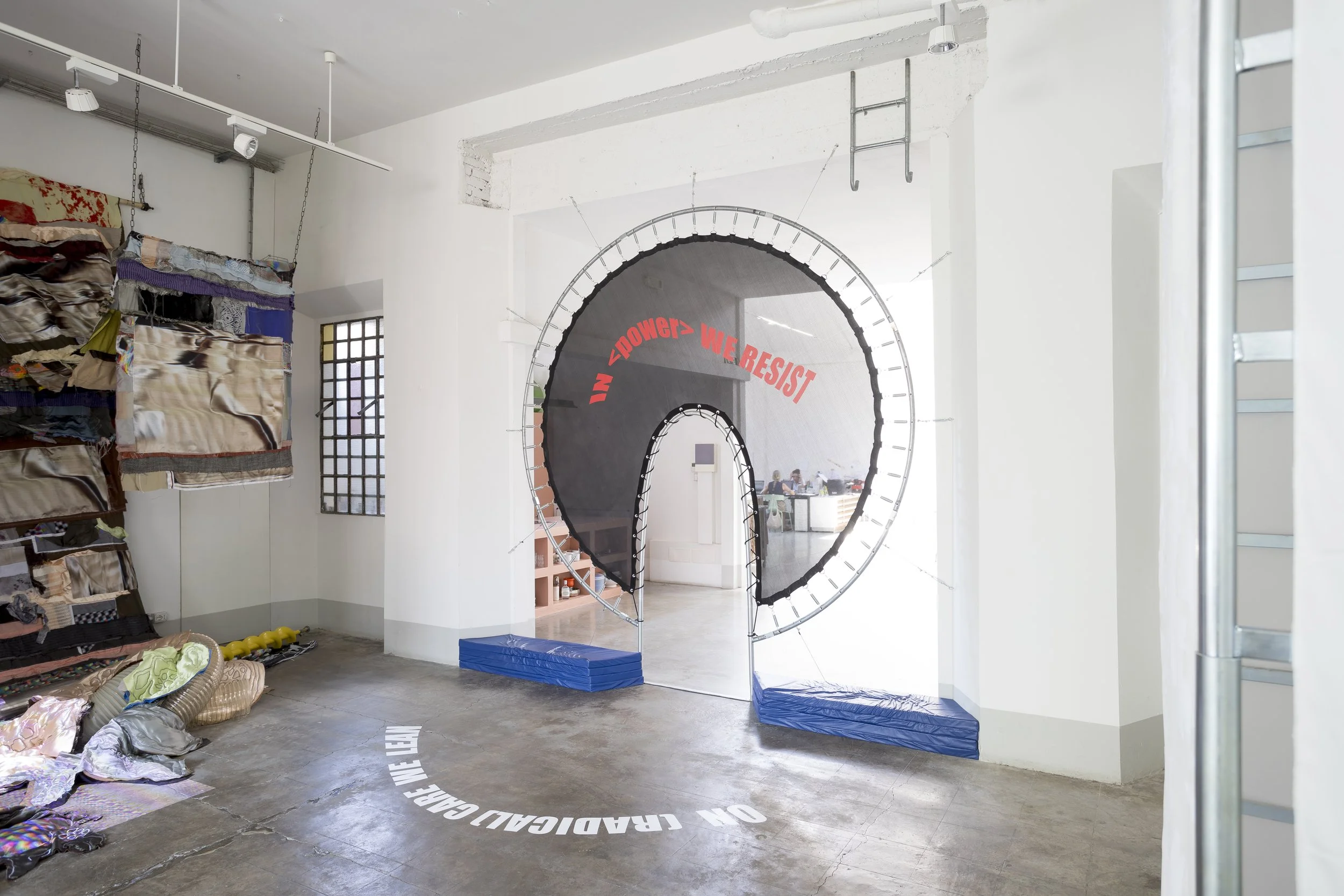
patron/ise, exhibition view, Lottozero Kunsthalle, Prato, 2026.
Photo: Alessandro Destro
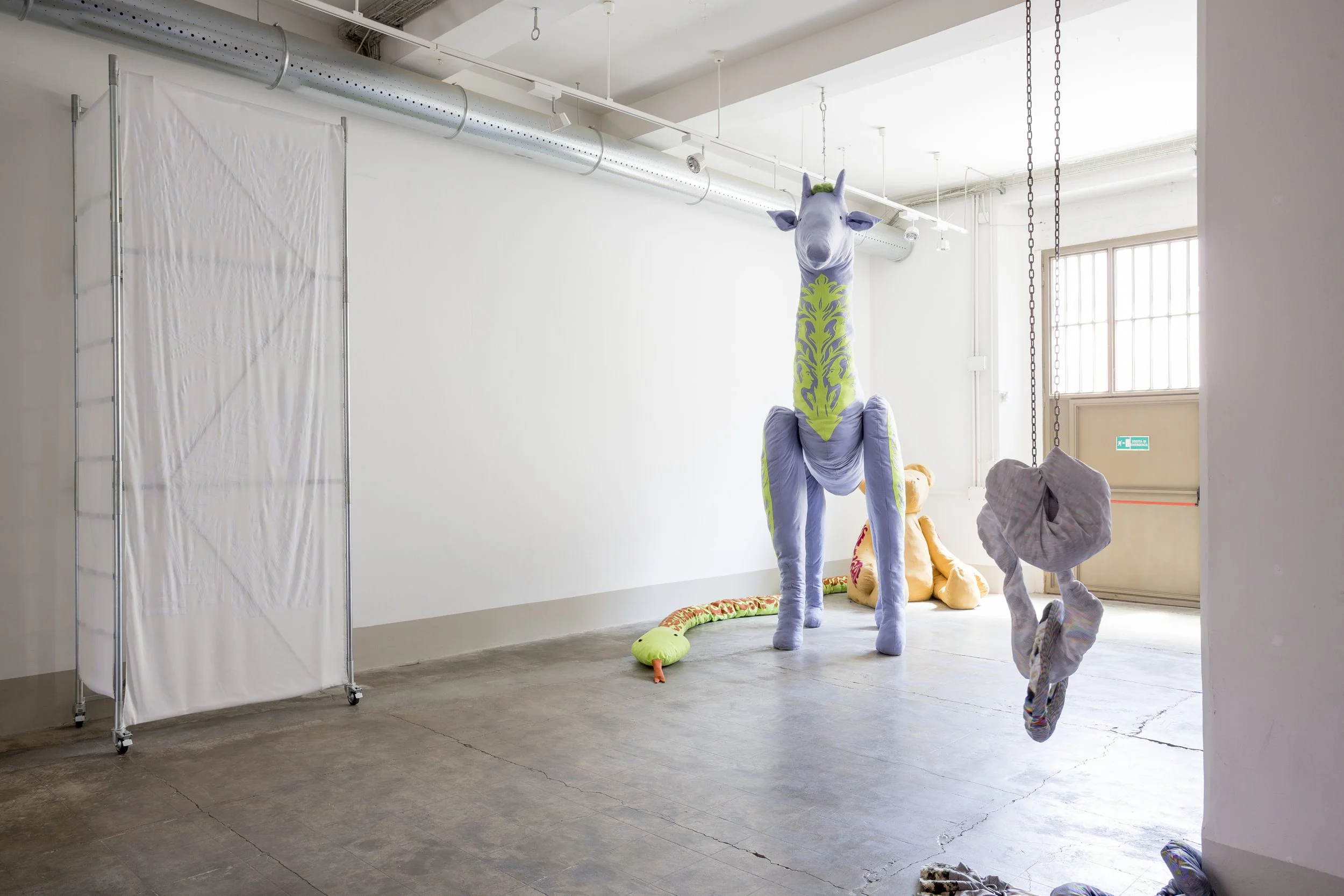
patron/ise, exhibition view, Lottozero Kunsthalle, Prato, 2026.
Photo: Alessandro Destro
14.07. —
11.10.2026
LORENA BUCUR, CARMEN BUONANNO, LINDA ANN CIPRIANI, NIKOLA FILIPOVIC’
curated by
ESTER MARIA D’AVOSSA
patron/ise reflects on the conditions that make artistic production possible and on the forms of labour, negotiation, and compromise that often remain hidden behind the finished work. The exhibition takes the artist residency as its point of departure: a space often imagined as a break from the pressures of everyday life, yet one that remains deeply embedded within the same economic, institutional, and social structures that shape the broader art system.
Produced over the course of six months in Prato, within the Textile Art Factory residency program, the works presented in the exhibition are deeply connected to the city's textile history and to the context of Macrolotto Zero, the district where Lottozero is located, a neighbourhood shaped by the industrial production of ready-to-wear fashion, migration, and forms of labour that often remain invisible. Like textile production itself, artistic production unfolds through successive processes: research, technical learning, failed attempts, conversations, physical effort, and continual adaptation. What the public ultimately encounters is the finished object, yet every work carries within it the traces of the systems, materials, gestures, and sacrifices that made it possible.
radical power, care and resistance
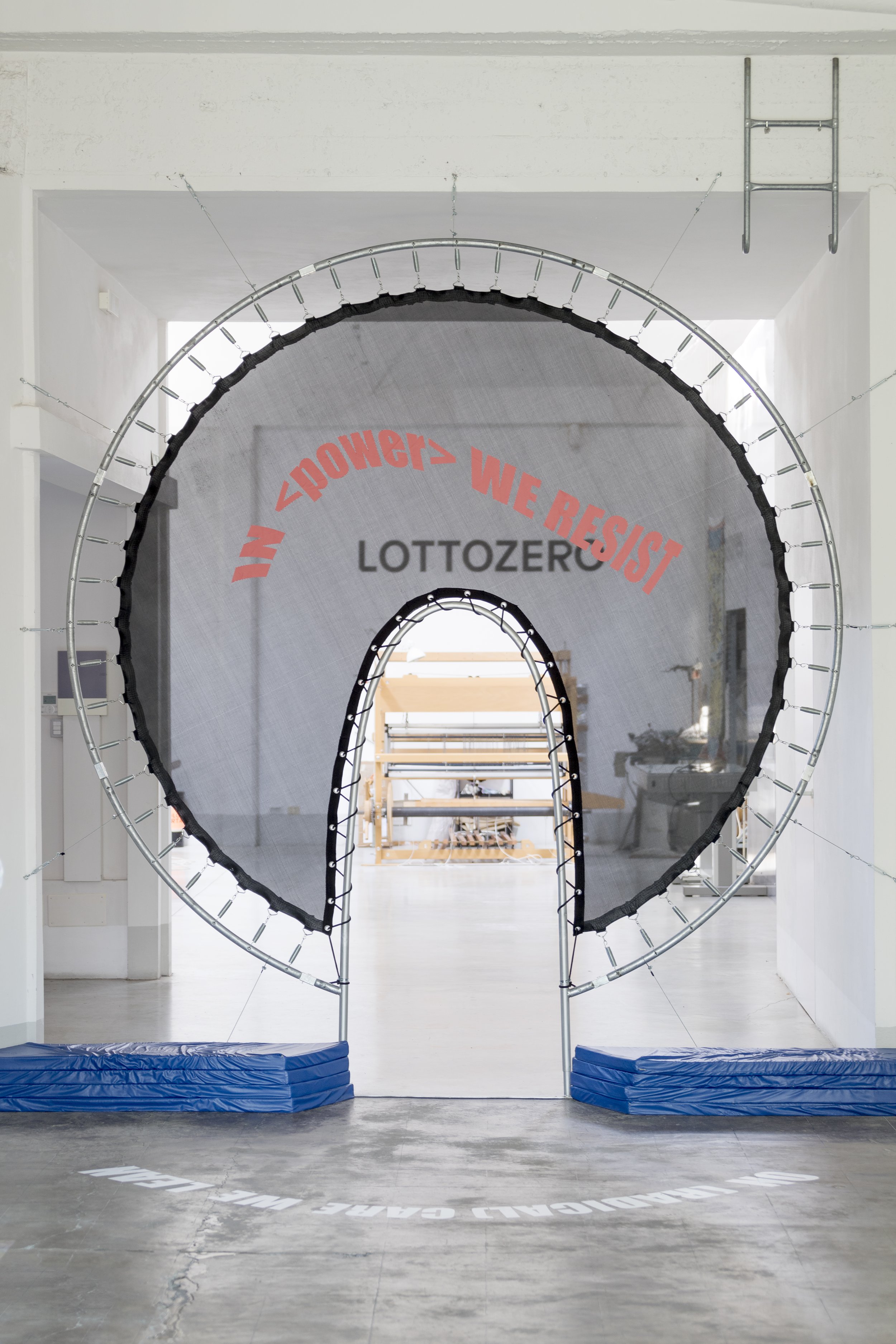
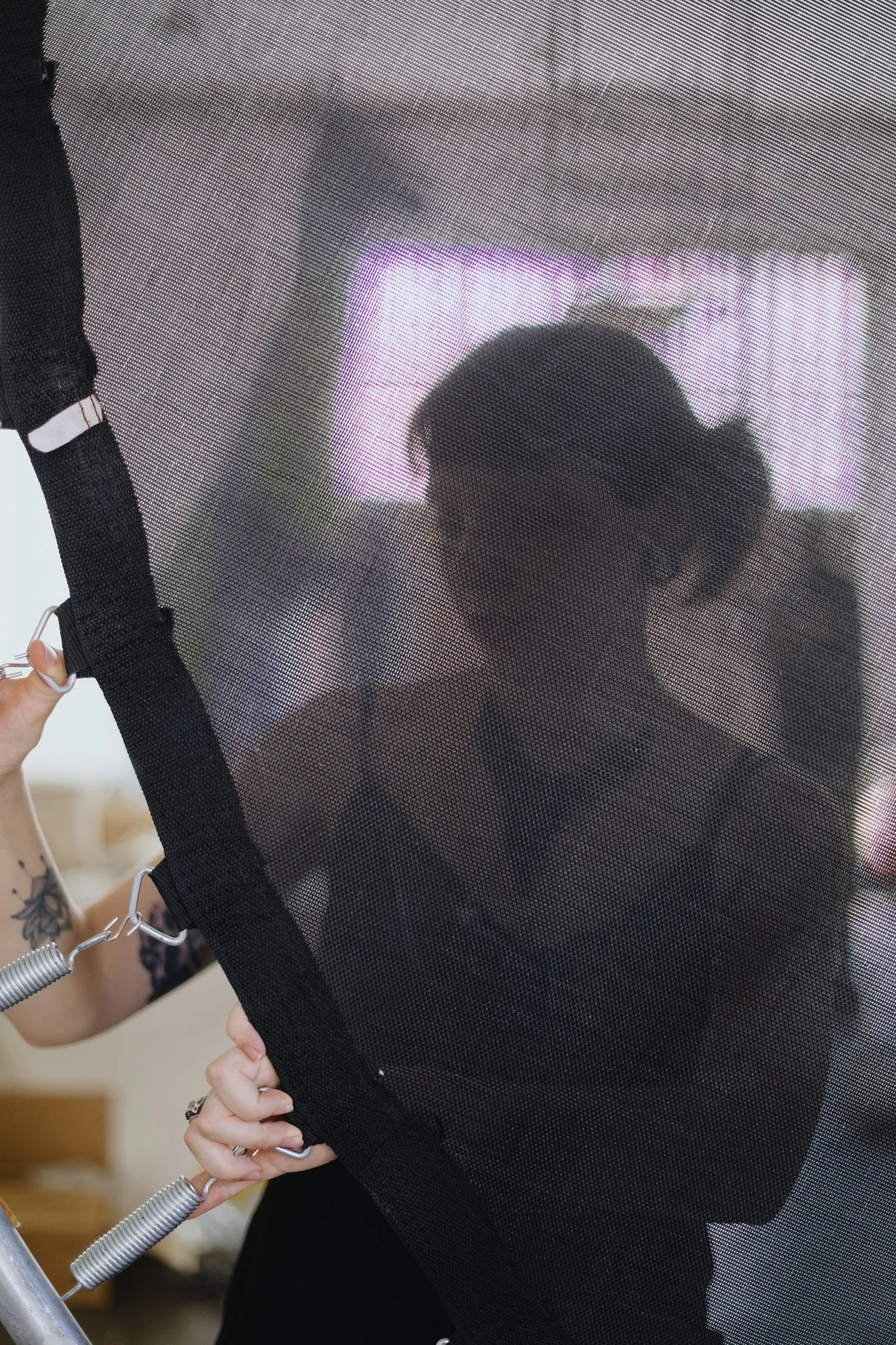
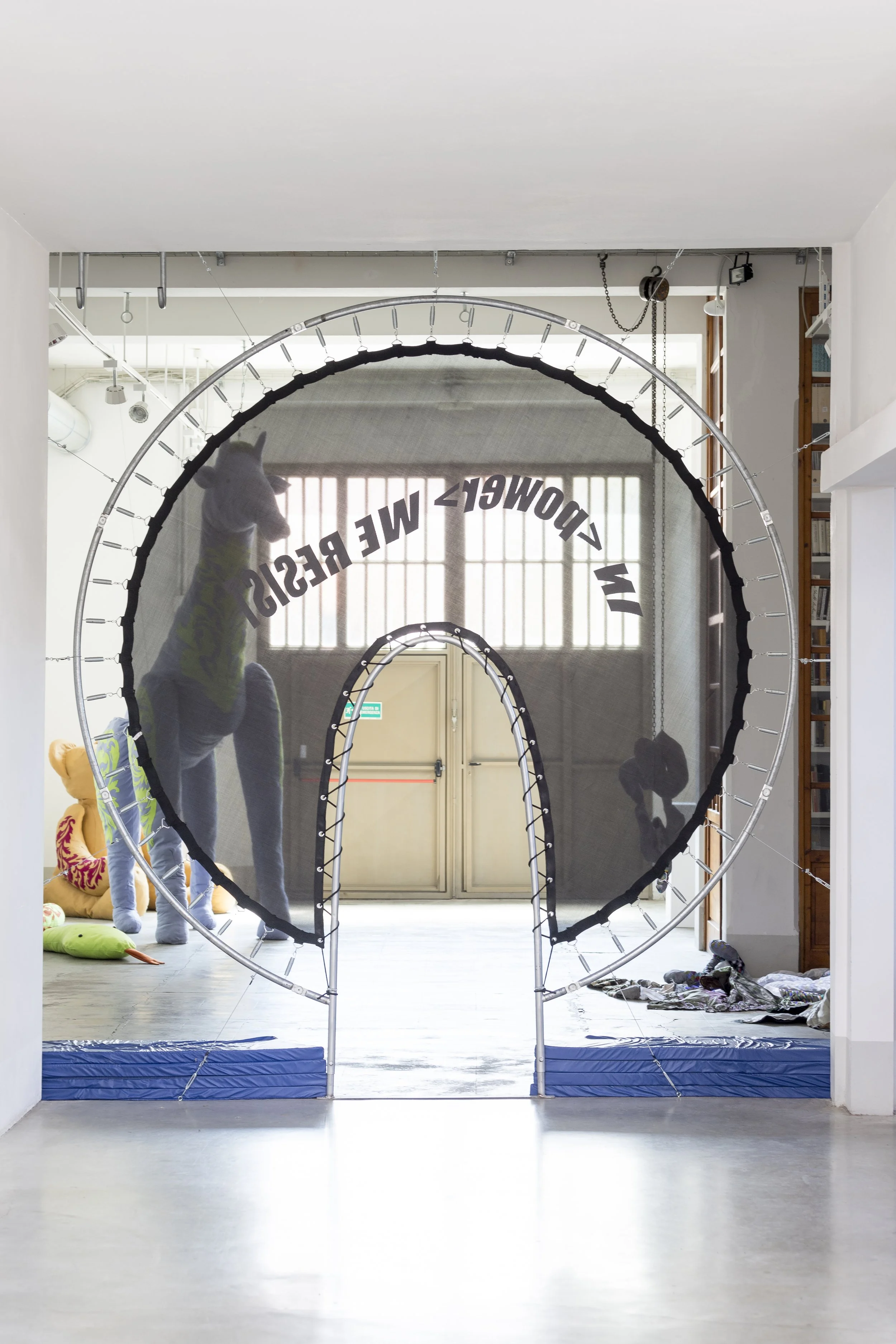
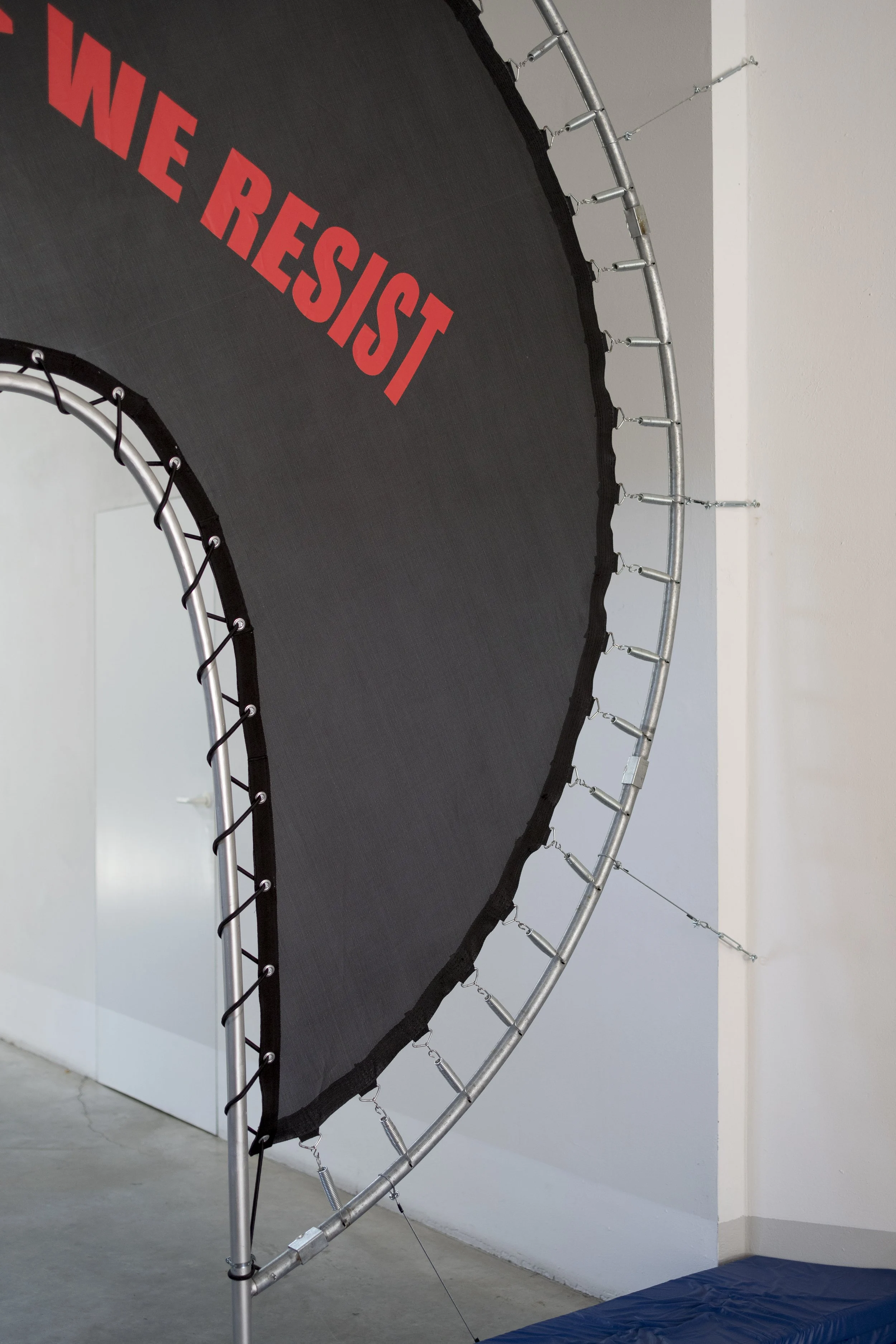
Radical Power by Carmen Buonanno transforms the threshold between the exhibition space and the remaining areas of Lottozero into a charged site of transition. Positioned vertically and held under tension by industrial tie rods, a trampoline becomes at once a barrier, a membrane, and a structure of resistance. Its elastic surface evokes pressure, rebound, impact, and bodily force. The installation incorporates the phrases In <power> we resist and On {radical} care we lean, connecting the work to protest banners, workers' demonstrations, and struggles surrounding labour and the rights of migrant workers in Prato's textile district.
For Buonanno, power is not simply a matter of domination or control. It also emerges when bodies gather, resist, and care for one another. The work asks how much pressure a body, a material, a space, or a community can absorb before that very pressure is transformed into resistance.
Outfit of the Night, n. 1-4, 2024, TC2-loom jacquard woven tapestries, mixed yarn weft, cotton warp. Photo: Alessandro Destro
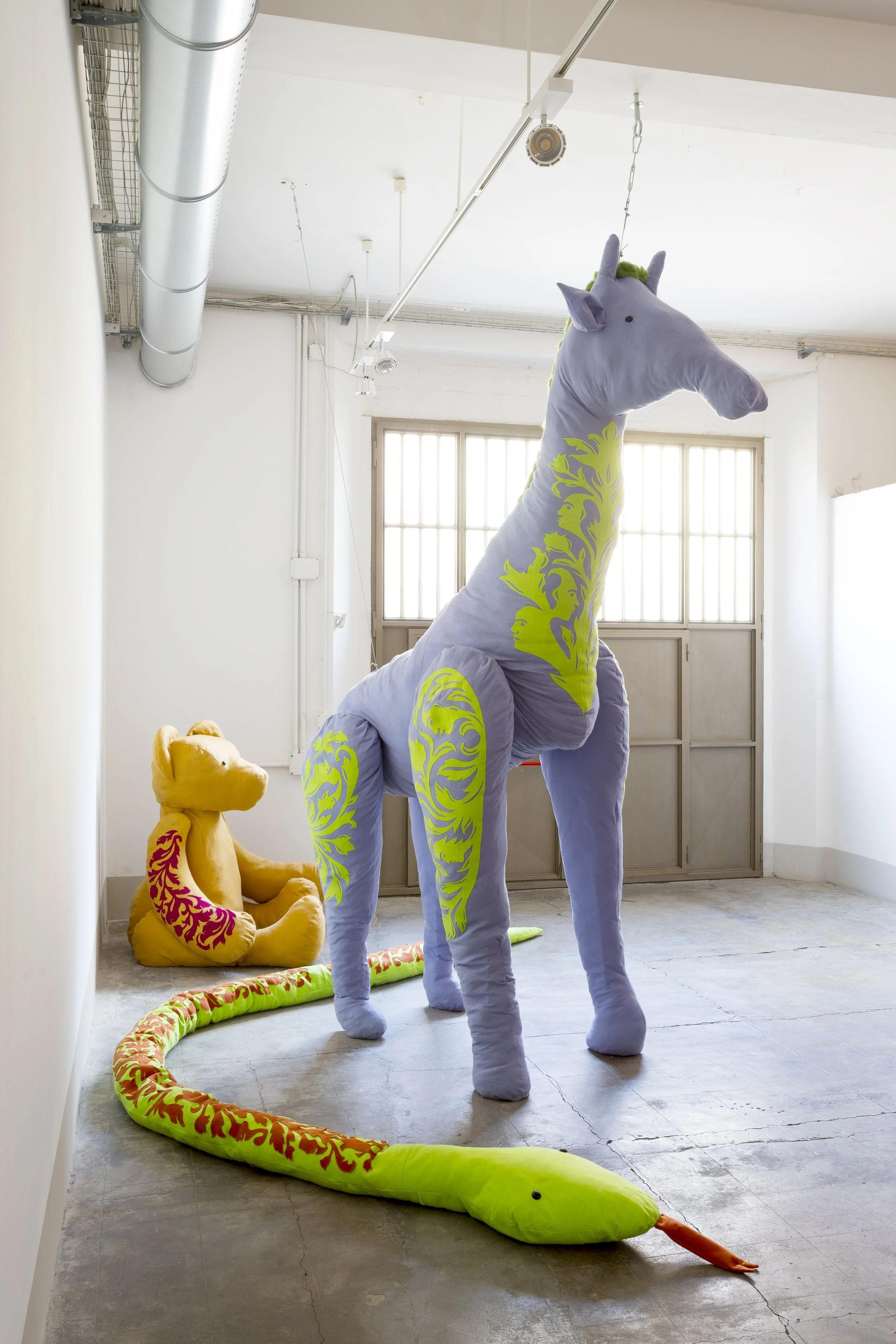
Super Sofa’s, the Fruits of the Loom edition, 2024-2025, jacquard, felt, mixed textile stuffing, fiberglass, stainless steel butcher’s hooks.
Photo: Alessandro Destro
inherited trauma
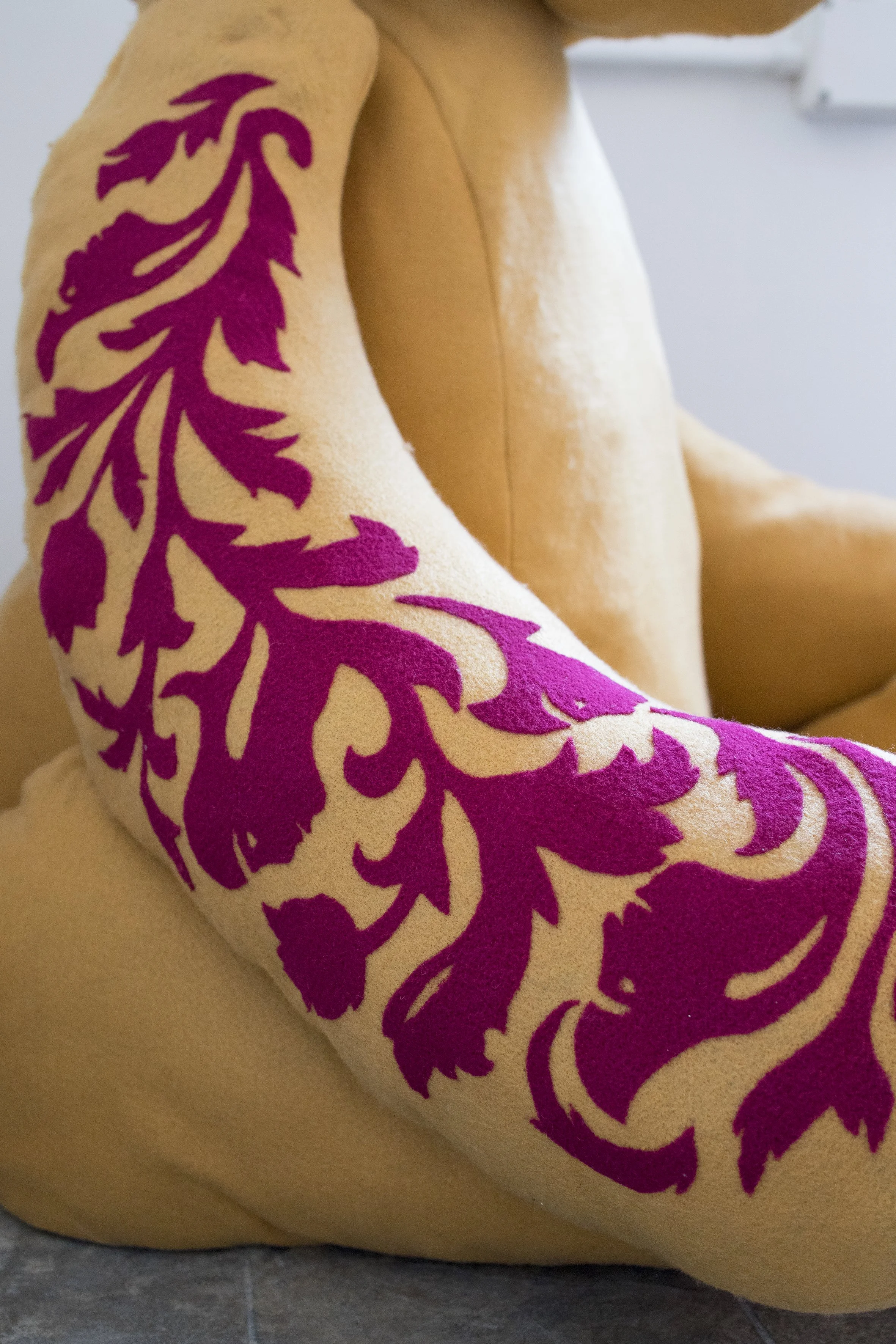
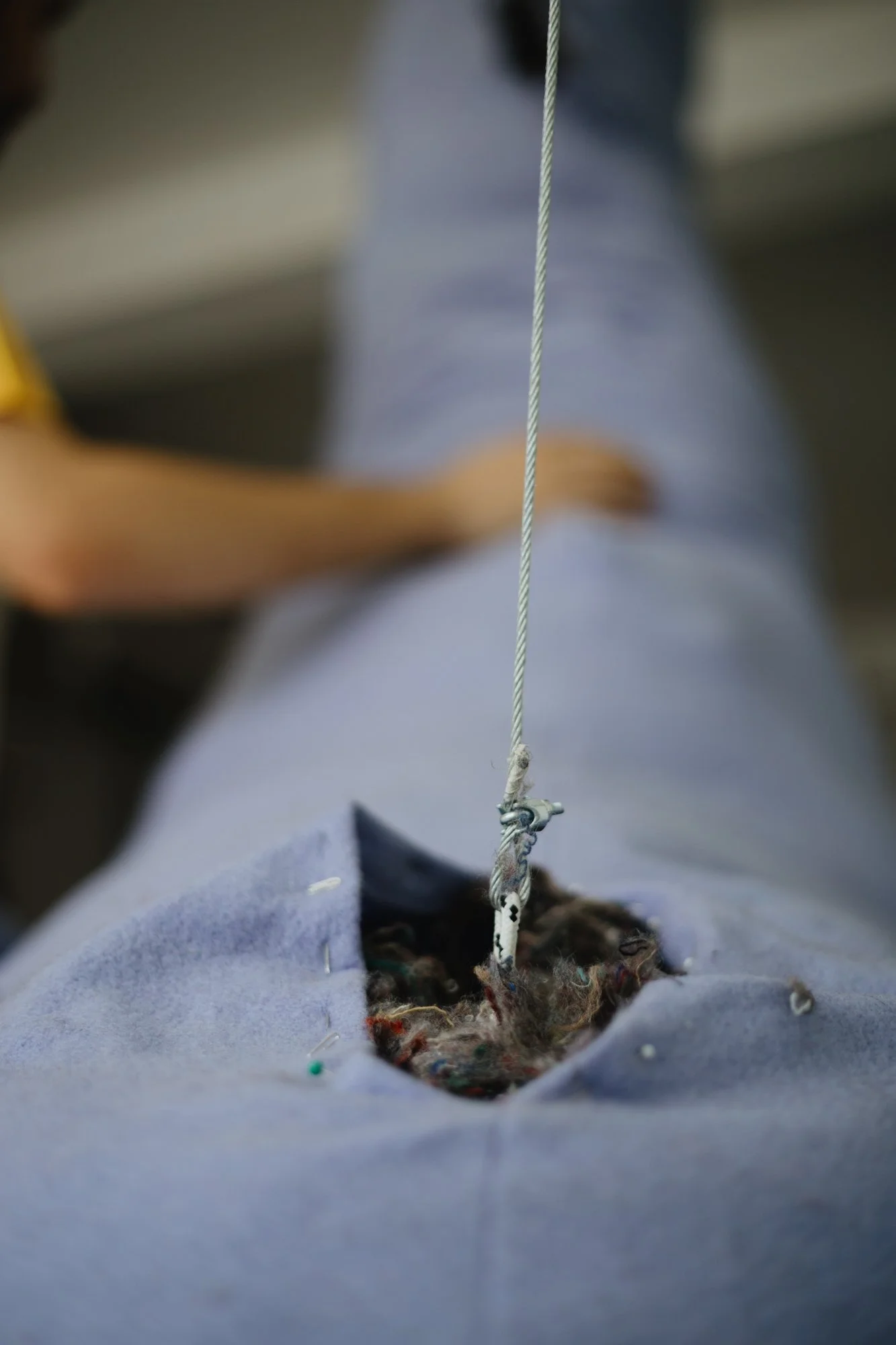
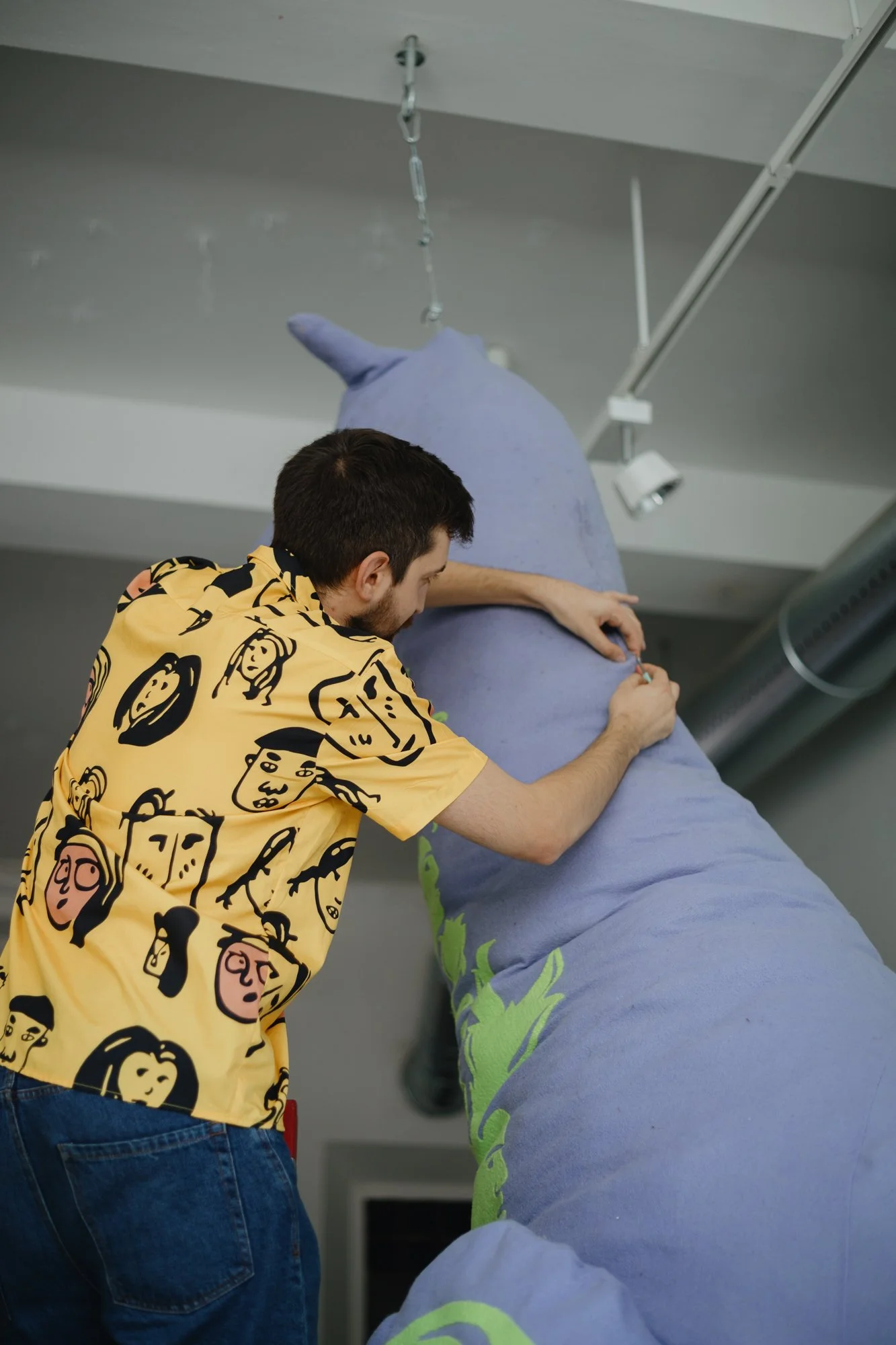
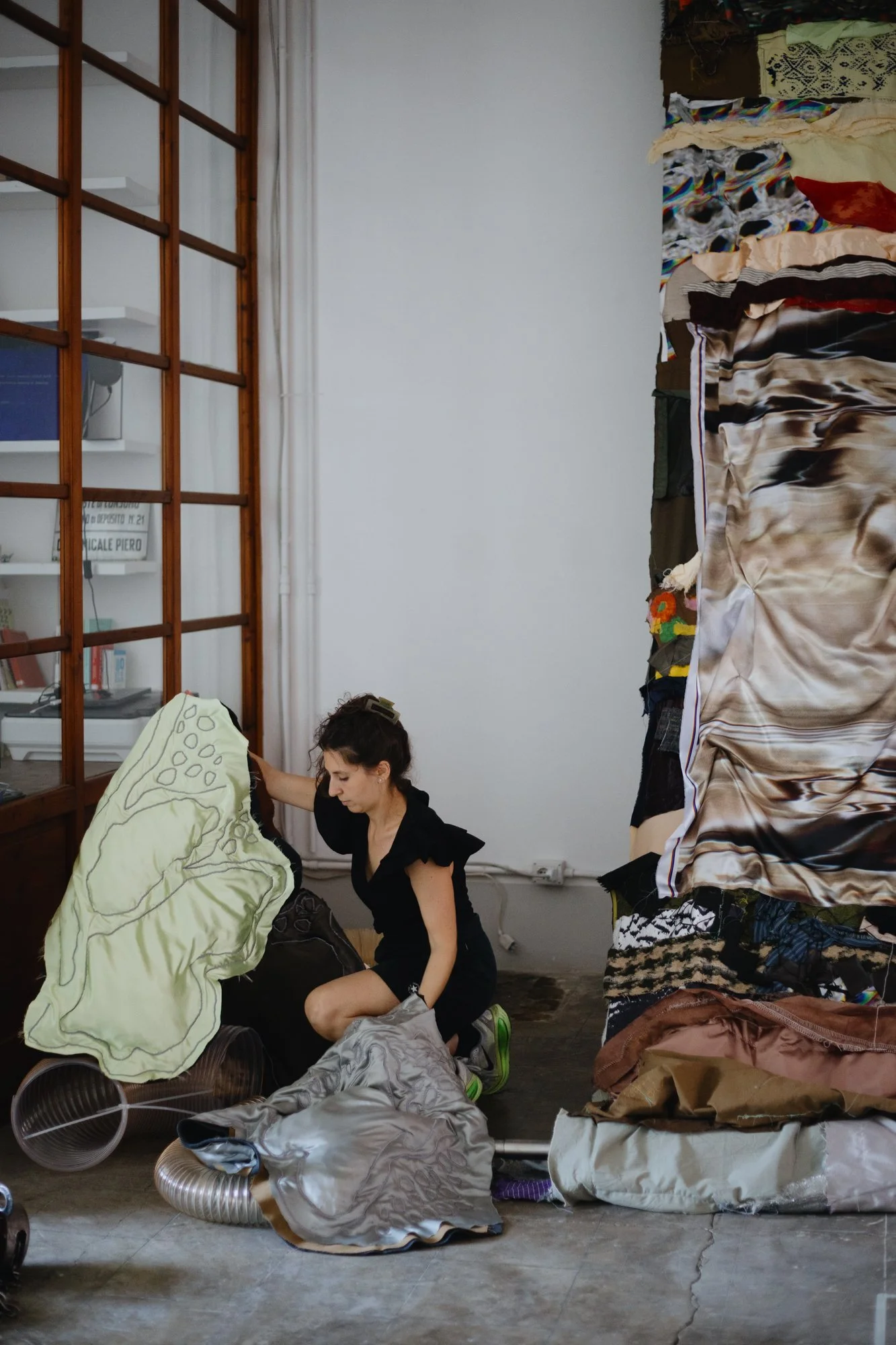
First Time Being Alive by Nikola Filipović begins from an intimate temporal coincidence: the artist has reached the same age his parents were when he and his sister were born. From this awareness, the work opens questions around childhood, inheritance, instability, and care. Emerging from memories shaped by the conditions of the post-war Balkans—marked by sanctions, inflation, and the scarcity of essential goods—the project takes the form of textile sculptures inspired by childhood plush toys. These are not faithful reconstructions but fictional objects: at once familiar and invented. Softness lies at the centre of the work, yet it does not coincide with innocence. Within a culture of childhood in which many toys are already embedded with references to violence, the plush toy becomes a protective, tactile, and tender object while still carrying complex histories. Its decorative patterns draw on Slavic domestic textile traditions, including family linens and the symbolism of the Tree of Life. By enlarging these childhood toys, Filipović reflects on the notion of inflation, on value, trauma, and on the possibility of transforming what is passed down across generations.
SYSTEMS OF INTERFERENCE
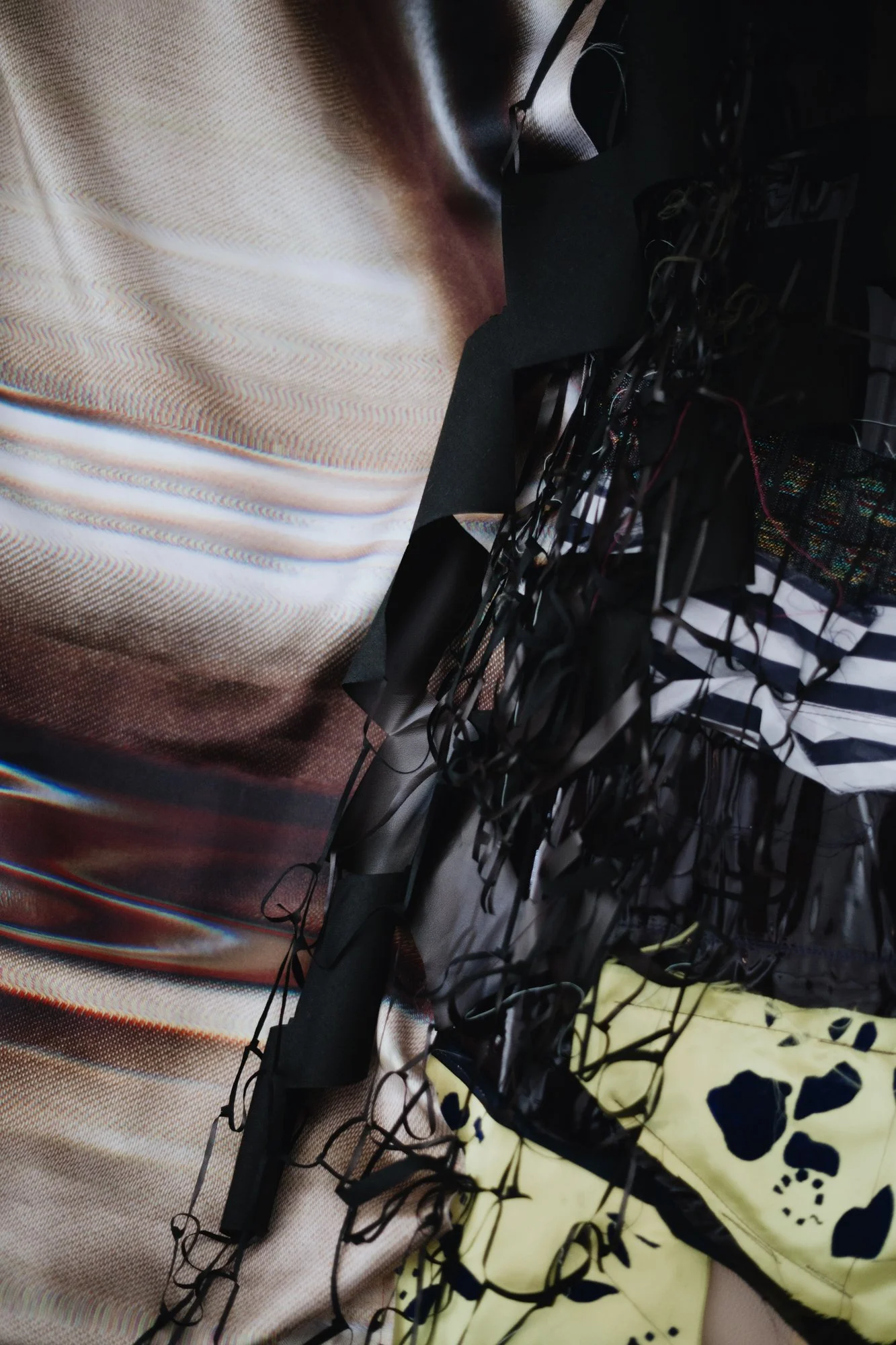
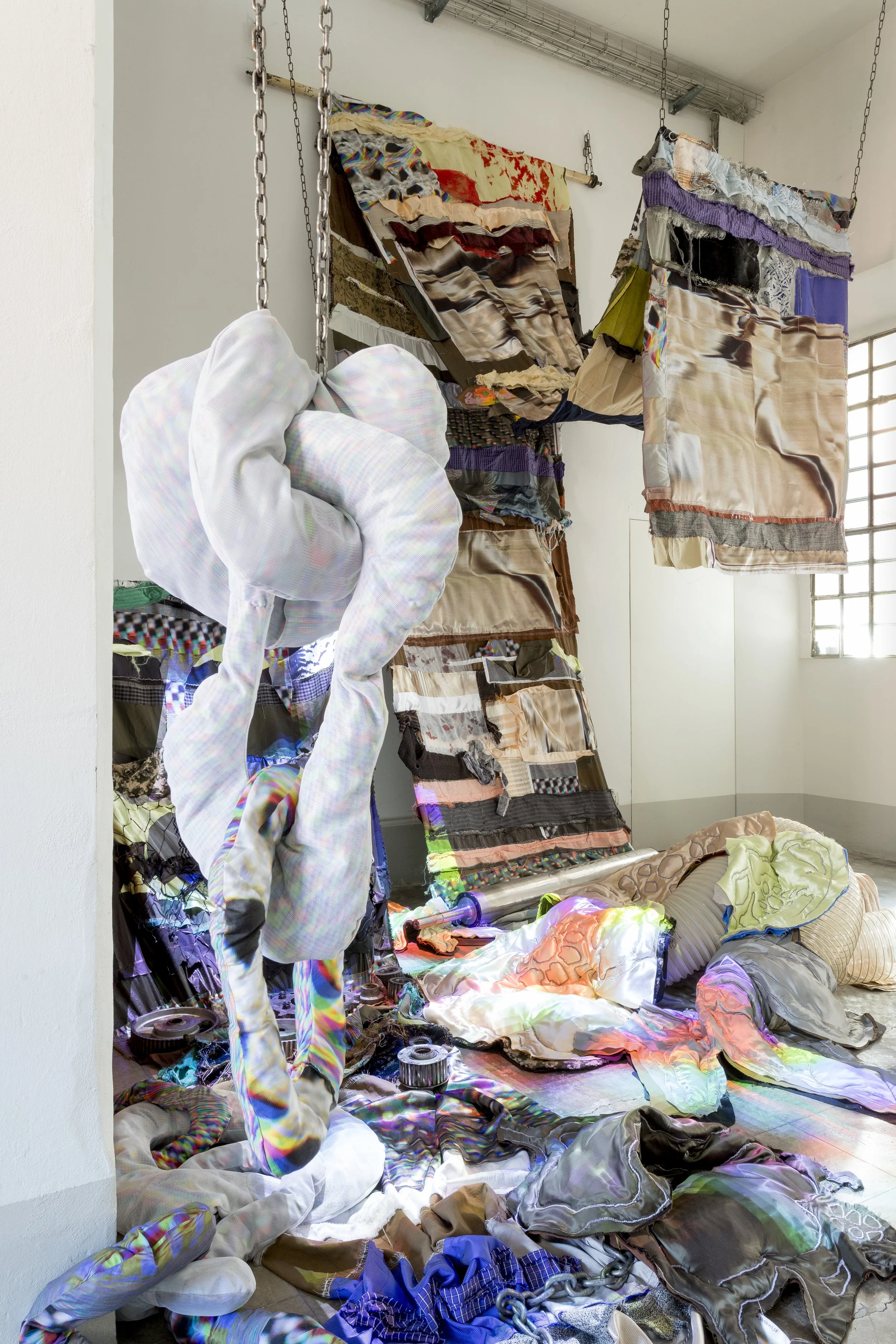
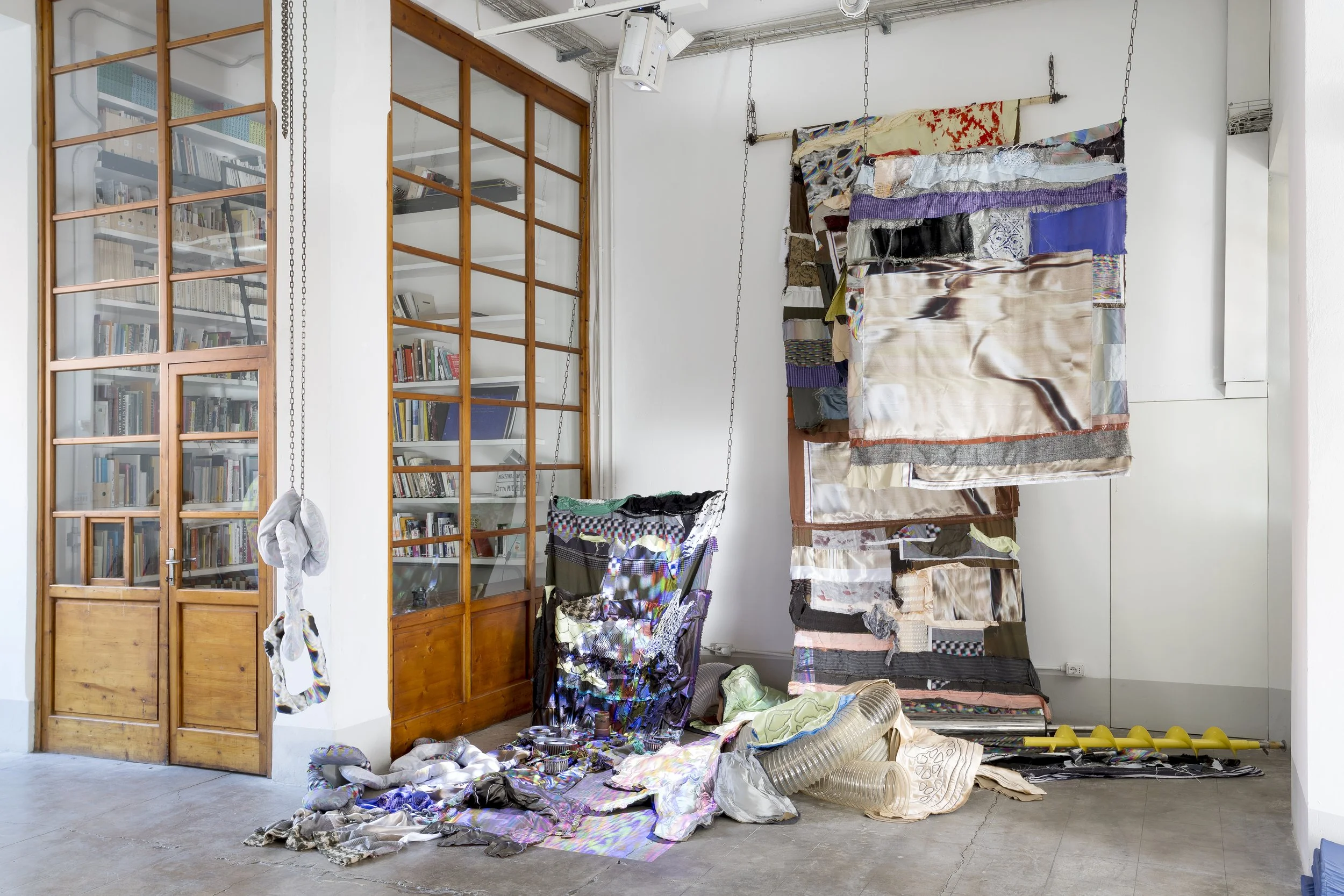
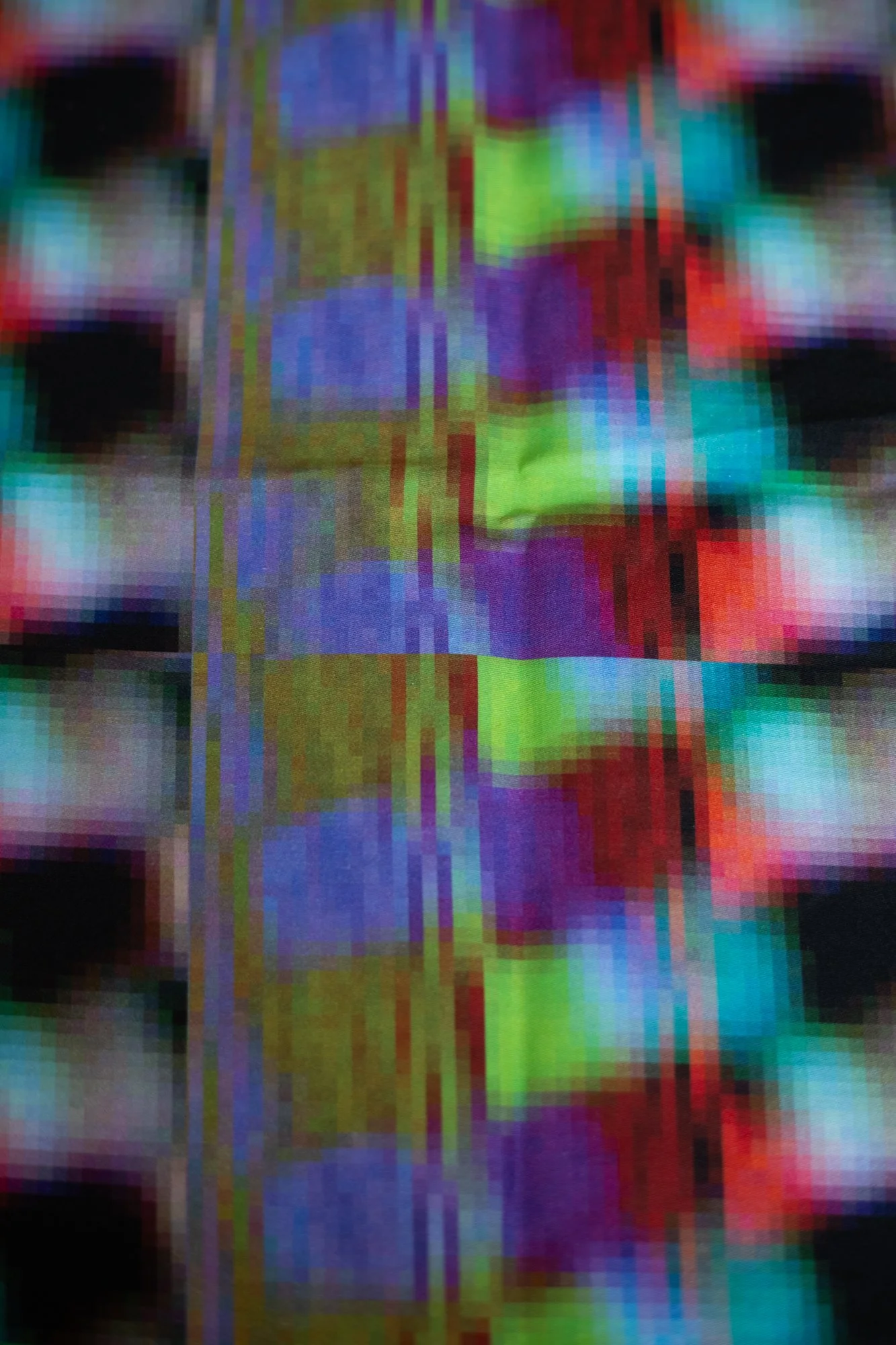
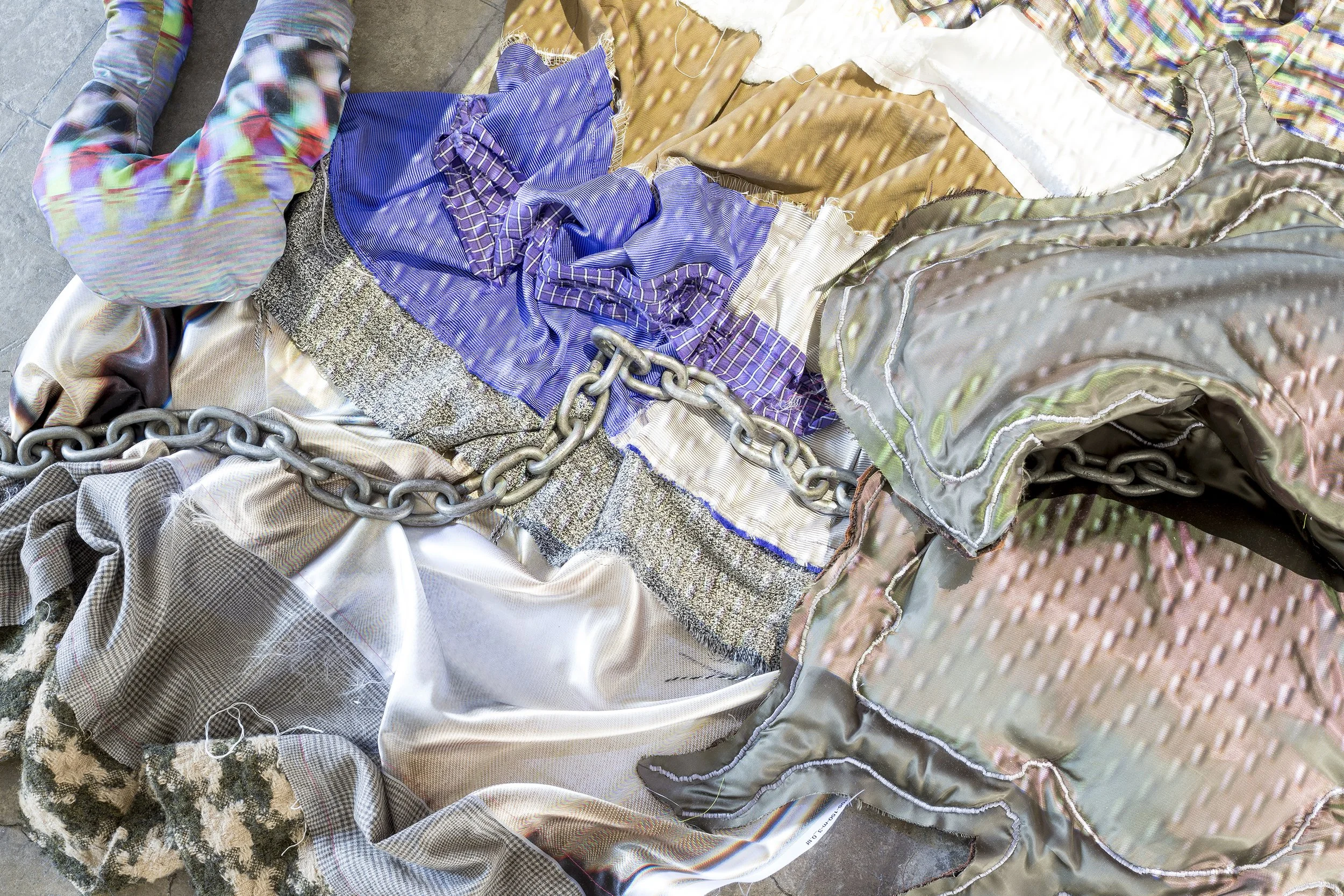
In Overprocessing the Net by Linda Ann Cipriani, textile becomes a network of tensions, errors, images, and transformations. Here, net refers simultaneously to the structure of woven cloth, the digital grid, the pixel, and the systems through which images, materials, and labour circulate. Cipriani's practice unfolds through a process of scanning, enlargement, folding, stitching, and recomposition. Digital images emerge through a direct encounter with textile matter, while visual artefacts such as the moiré effect expose the hidden structures underlying both textile construction and digital vision. Throughout the residency, discarded fabrics, workshop experiments, and industrial materials collected in Prato became integral to the installation. Components of textile machinery, removed from their original function, reappear as weights, supports, and sources of tension. In doing so, the work brings into view the labour, residues, dependencies, and technical processes that are typically absorbed into the finished surface.
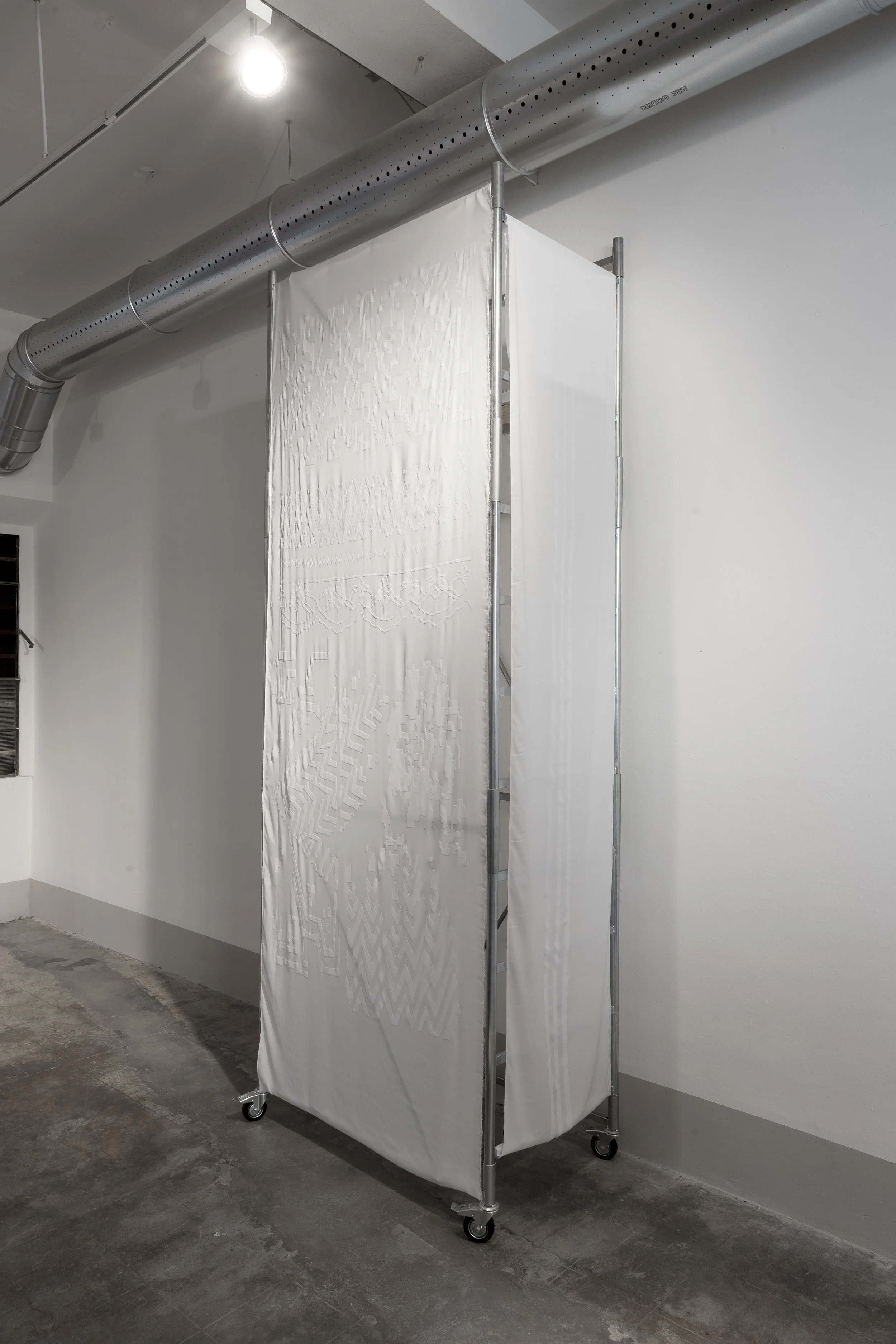
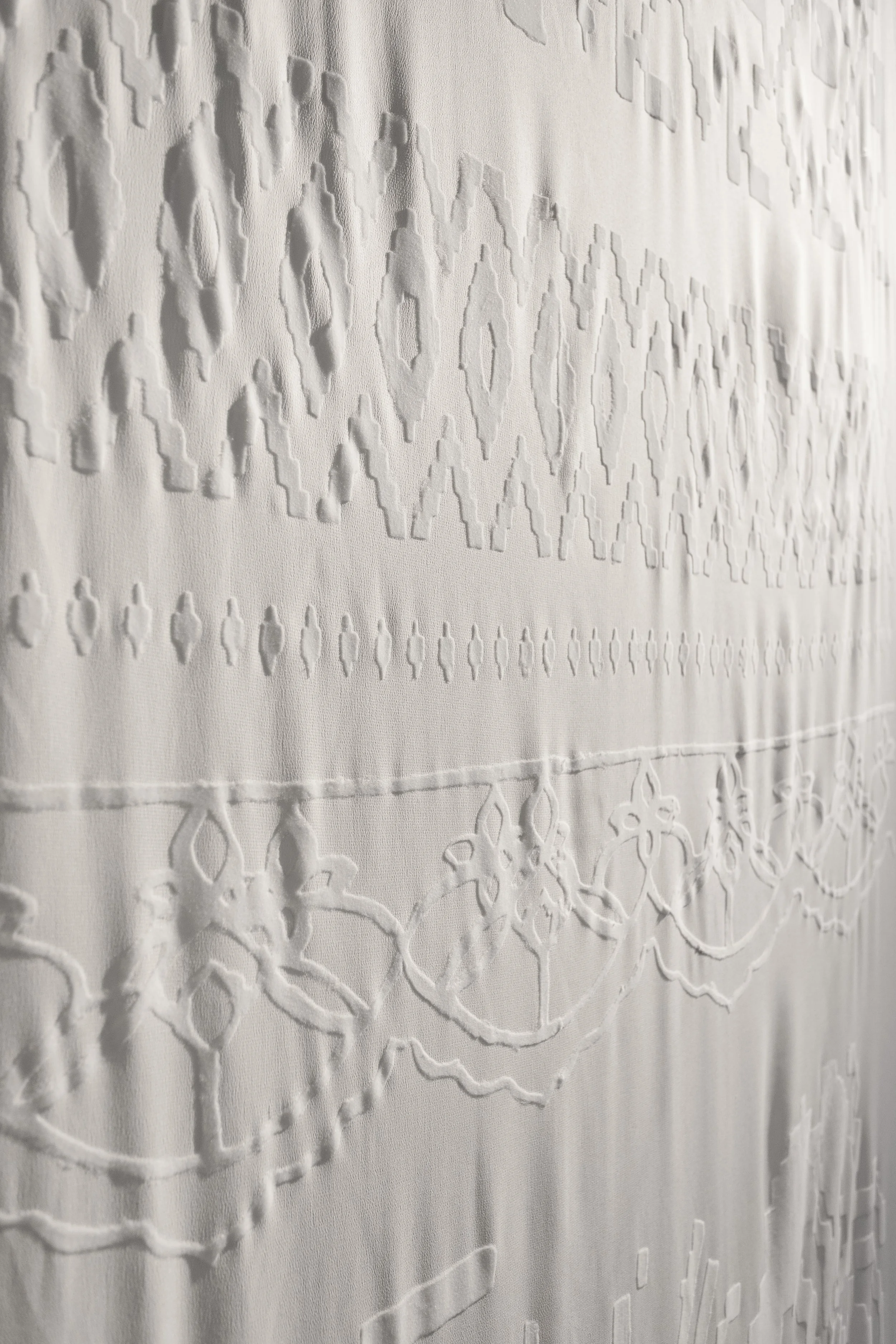
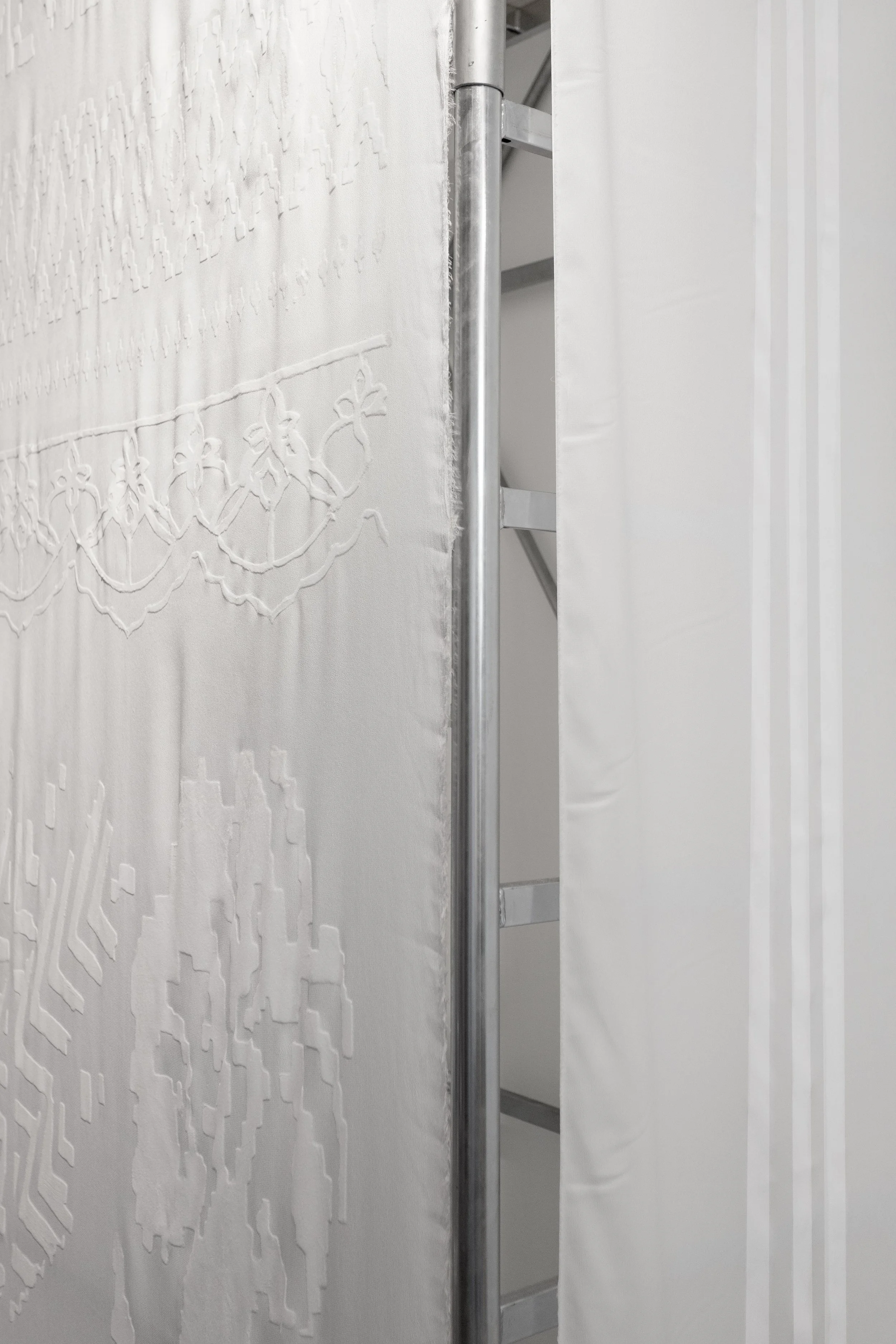
White n.1 by Lorena Bucur begins with a photograph taken by the artist's father in her grandmother's home, later reworked by Bucur herself. In the original image, textiles inhabit the domestic space: carpets cover the floor, blankets rest on the bed, each decorated with traditional Romanian motifs. Rather than inventing a new visual language, Bucur works from what already exists, treating the photograph as a fragment of inherited memory that is reconfigured into new patterns. These patterns also incorporate signs of modernity that have become cultural stereotypes associated with Eastern Europe, such as the Adidas logo, recalling histories of counterfeiting and smuggling. Through flock printing, the photograph is translated into a white-on-white textile surface—fragile, delicate, and almost imperceptible. As its support, Bucur introduces scaffolding, a structure commonly associated with construction sites and manual labour. For the artist, scaffolding is what allows another structure to exist: without it there is no house, no shelter, no domestic space, no memory. The work brings lightness into dialogue with weight, intimacy with politics, and visibility with invisibility, revealing the forms of labour and care that sustain the structures around us while so often remaining unseen.
Photos: Alessandro Destro

